
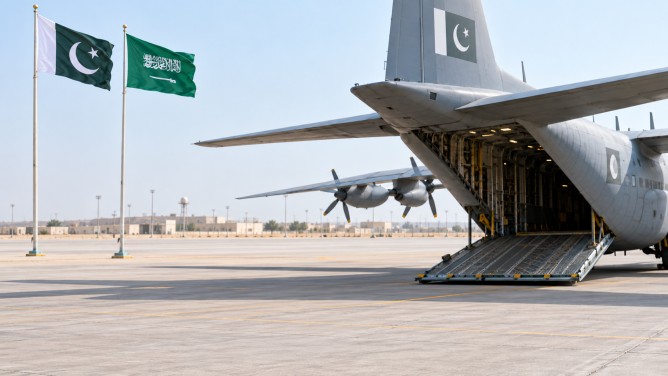
Pakistan has confirmed the deployment of a significant number of its military personnel in Saudi Arabia as part of a joint defense agreement aimed at bolstering the kingdom’s territorial security. This development was announced by Pakistan’s Foreign Ministry spokesperson, Sajjad Haider Khan, who emphasized that the troops are stationed in Riyadh for defensive purposes only.
The deployment comes under the framework of the Makkah Joint Defence Agreement, signed on August 7, 2026, by Pakistan, Saudi Arabia, and Türkiye. This pact establishes a security alliance among the three nations, committing them to respond collectively to any armed attack against one of the signatories. The agreement signifies a step towards enhanced regional security cooperation.
Clarifying the nature of the military presence, Khan stated that the Pakistani forces are not in Saudi Arabia to engage in cross-border operations against Yemen’s Houthi forces. Instead, their role is strictly to assist in the protection of Saudi territory. This statement aims to dispel any misconceptions regarding Pakistan’s military engagement in the conflict involving Yemen.
Pakistan’s military has also confirmed the deployment, indicating that its personnel are involved in various operational roles under the joint defense agreement. This collaboration reflects the longstanding military relationship between Pakistan and Saudi Arabia, now formalized through this trilateral defense pact which includes Türkiye.
While the specifics of the operations or the number of troops involved have not been detailed, the focus remains on reinforcing Saudi Arabia’s defense capabilities. This strategic move underscores the importance of mutual security interests among the signatories in a region often characterized by geopolitical tensions.
The Makkah Joint Defence Agreement represents a significant commitment to collective security, highlighting the participating countries’ intent to stand united against external threats. As regional dynamics continue to evolve, this pact could play a crucial role in shaping the security landscape in the Middle East.