
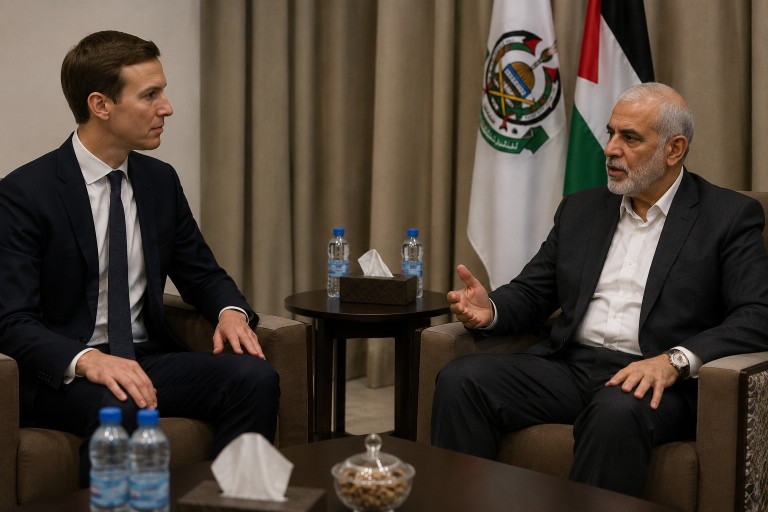
In a renewed bid to advance a stalled ceasefire plan in Gaza, Jared Kushner, son-in-law and envoy of former U.S. President Donald Trump, engaged in discussions with Hamas political leader Khalil al-Hayya in Egypt on Sunday. This diplomatic effort precedes Kushner’s scheduled meeting with Israeli Prime Minister Benjamin Netanyahu, who has recently turned down a U.S.-endorsed 15-point strategy for the ceasefire’s next phase.
The proposed plan aims for Hamas to relinquish its weapons gradually, while Israel agrees to cease military actions and withdraw from certain areas of Gaza. It also outlines plans for reconstruction and the deployment of international forces to ensure security. Despite agreeing to the roadmap, Hamas has conditioned its disarmament on Israel halting attacks and retreating to a previously agreed demarcation, known as the “yellow line.” Additionally, Hamas links giving up its heavier weapons to achieving progress toward establishing a Palestinian state, a notion Netanyahu’s administration opposes.
Netanyahu has maintained that a complete withdrawal of Israeli forces from Gaza is contingent upon Hamas’s total disarmament. This impasse has hindered crucial components of the ceasefire plan, including reconstruction efforts and the deployment of international peacekeepers. Kushner’s meeting with Hamas, which saw participation from officials from Egypt, Qatar, and Turkey, aimed to secure Hamas’s agreement to disarmament terms before his discussions with Netanyahu.
In addition to his meeting with Netanyahu, Kushner is expected to be accompanied by former British Prime Minister Tony Blair and Nickolay Mladenov, the Board of Peace director. Several regional powers, such as Saudi Arabia, the United Arab Emirates, Jordan, Pakistan, and Indonesia, have voiced disapproval of Israel’s rejection of the U.S.-backed roadmap, urging swift action to avoid further postponements.
This diplomatic initiative emerges as Netanyahu encounters political pressure with an impending October election in Israel. His ruling coalition includes ministers advocating for a stricter stance on Gaza, casting uncertainty over the ceasefire plan’s future.